Zum Inhalt springen

Das Kleinhirn

und seine coolen Mindmaps

  • Start
  • Reisen
  • Programmierung
  • Medizin
  • Kontakt
  • Impressum
  • Datenschutzhinweis
Veröffentlicht am 11. August 202310. August 2023 von Thomas Wenzlaff

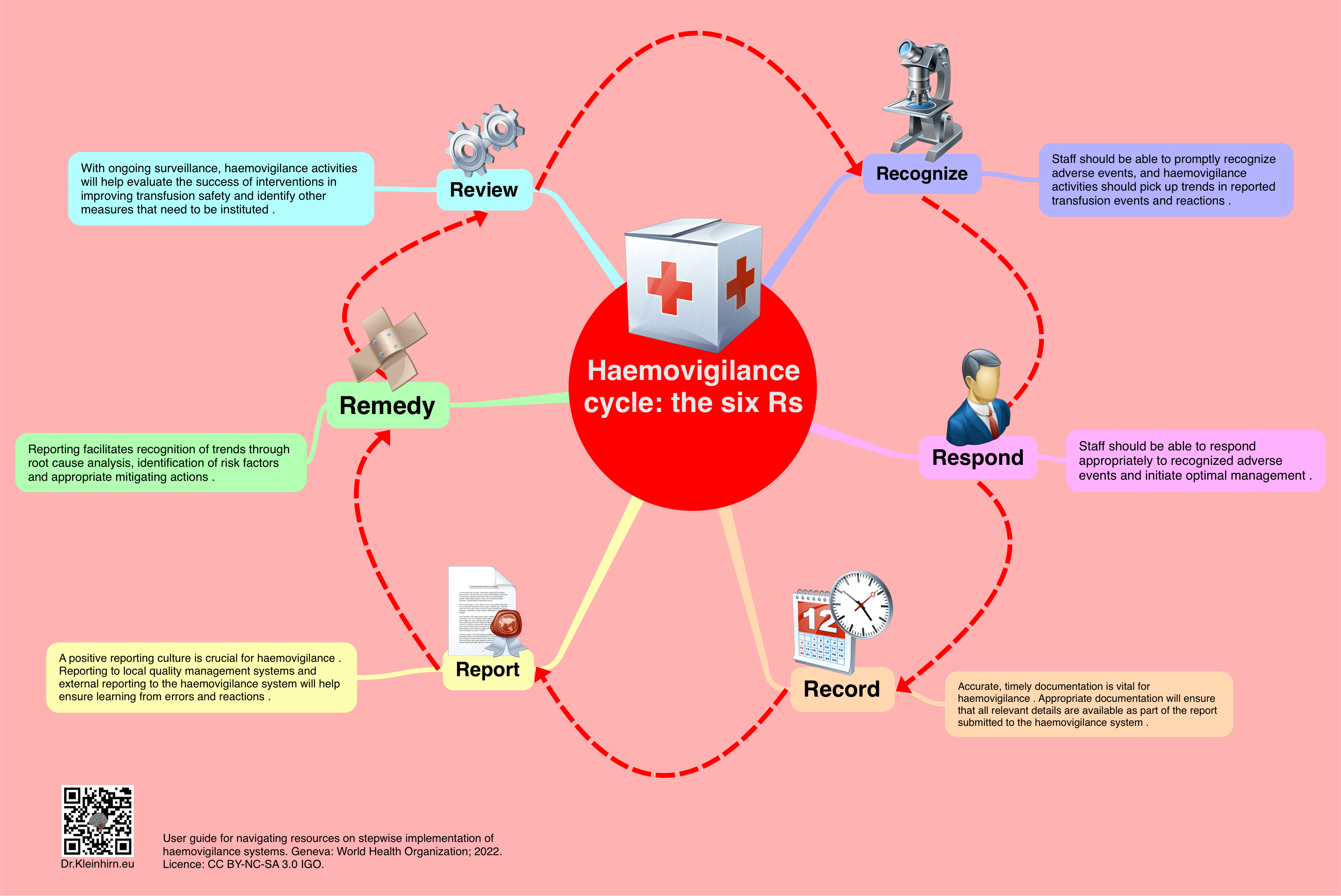
Haemovigilance cycle: the six Rs

The six Rs of the haemovigilance cycle can be defined as follows.

Recognize. Staff should be able to promptly recognize adverse events, and haemovigilance activities should pick up trends in reported transfusion events and reactions .
Respond. Staff should be able to respond appropriately to recognized adverse events and initiate optimal management .
Record. Accurate, timely documentation is vital for haemovigilance . Appropriate documentation will ensure that all relevant details are available as part of the report submitted to the haemovigilance system.
Report. A positive reporting culture is crucial for haemovigilance .
Reporting to local quality management systems and external reporting to the haemovigilance system will help ensure learning from errors and reactions .
Remedy. Reporting facilitates recognition of trends through root cause analysis, identification of risk factors and appropriate mitigating actions .
Review. With ongoing surveillance, haemovigilance activities will help evaluate the success of interventions in improving transfusion safety and identify other measures that need to be instituted .

Der Hämovigilanzzyklus bezieht sich auf die Überwachung und Sicherstellung der Sicherheit von Blut und Blutprodukten während des gesamten Prozesses, von der Spende bis zur Verwendung. Die sechs Rs stellen eine systematische Methode dar, um die Qualität und Sicherheit des Bluts zu gewährleisten und potenzielle Risiken für Spender und Empfänger zu minimieren.

Die sechs Rs des Hämovigilanzzyklus können wie folgt definiert werden.

Erkenne. Das Personal sollte in der Lage sein, unerwünschte Ereignisse umgehend zu erkennen, und Hämovigilanz-Aktivitäten sollten Trends bei gemeldeten Transfusionsereignissen und -reaktionen erfassen.
Antworten. Das Personal sollte in der Lage sein, angemessen auf erkannte unerwünschte Ereignisse zu reagieren und eine optimale Behandlung einzuleiten.
Aufzeichnen. Eine genaue und zeitnahe Dokumentation ist für die Hämovigilanz von entscheidender Bedeutung. Durch eine entsprechende Dokumentation wird sichergestellt, dass alle relevanten Details im Rahmen des an das Hämovigilanzsystem übermittelten Berichts verfügbar sind.
Bericht. Eine positive Berichtskultur ist für die Hämovigilanz von entscheidender Bedeutung.
Durch die Berichterstattung an lokale Qualitätsmanagementsysteme und die externe Berichterstattung an das Hämovigilanzsystem wird sichergestellt, dass aus Fehlern und Reaktionen gelernt wird.
Abhilfe. Die Berichterstattung erleichtert das Erkennen von Trends durch Ursachenanalyse, Identifizierung von Risikofaktoren und geeignete Abhilfemaßnahmen.
Rezension. Bei fortlaufender Überwachung werden Hämovigilanz-Aktivitäten dazu beitragen, den Erfolg von Interventionen zur Verbesserung der Transfusionssicherheit zu bewerten und andere Maßnahmen zu identifizieren, die eingeleitet werden müssen.

User guide for navigating resources on stepwise implementation of
haemovigilance systems. Geneva: World Health Organization; Licence: CC BY-NC-SA 3.0 IGO.

Download haemovigilance.pdf.

Ähnliche Artikel:

  1. Drei Säulen des Patient Blood Management (PBM)
  2. Sepsis
  3. Acetylcholin
KategorienBedeutung, Dr.Kleinhirn.eu, Gesundheit, Medizin, Sicherheit Schlagwörteractivities should pick up trends in reported, adverse events, and appropriate mitigating actions ., and haemovigilance, blood, Blut, cycle: the six Rs, Dr. Kleinhirn.eu, ensure learning from errors and reactions ., events and initiate optimal management ., external reporting to the haemovigilance system will help, Haemovigilance, haemovigilance activities, Haemovigilance cycle: the six Rs, haemovigilance systems. Geneva: World Health Organization; 2022., Hämovigilanzzyklus, identification of risk factors, improving transfusion safety and identify other, measures that need to be instituted ., Patient Blood Management, Recognize, Record Accurate, Remedy, ReportA positive reporting culture is crucial for haemovigilance . Reporting to local quality management systems and, Reporting facilitates recognition of trends through, Respond Staff should be able to respond appropriately to recognized adverse, Review, root cause analysis, Staff should be able to promptly recognize, submitted to the haemovigilance system ., that all relevant details are available as part of the report, timely documentation is vital for haemovigilance . Appropriate documentation will ensure, transfusion events and reactions ., User guide for navigating resources on stepwise implementation of, will help evaluate the success of interventions in, With ongoing surveillance

Beitrags-Navigation

Vorheriger BeitragZurück Wie Feedback besser annehmen?
Nächster BeitragWeiter Kortisol (vs. Medikament Kortison)

History

  • Präoperative Anämie (ALICE-Studie)
  • Entscheiden mit Augenmaß (aus Entwickler-Sicht)
  • Respect Putting Respect into Practice – Checklist
  • Respekt in der Praxis zeigen (Checkliste)
  • Respekt zeigen
  • „Glück“ – Sprachvergleich
  • Eternal Happiness
  • Gesundheit
  • Gesunde Lebenserwartung (Healthy Life Years – HLY -/- Disability-Adjusted Life Years – DALY)
  • Salutogenese
  • 7-38-55-Regel (Mehrabian-Regel)
  • Glücksranking Deutschland 2025
  • Nukleare Kapazität 2025
  • aha
  • Jugendwort des Jahres 2025-2015
  • Git Branch Strategie
  • Git Workflow – Vorteile und Nachteile
  • PEM-Format (Privacy-Enhanced Mail)
  • Linux Kommandozeilen Shortcuts
  • Hashi Corp Vault

Kategorien

  • Arbeit
  • Artikel
  • Bedeutung
  • Computer
  • Crypto
  • Dr.Kleinhirn.eu
  • Englisch
  • Ernährung
  • Gesundheit
  • Kommunikation
  • Medizin
  • Mermaid
  • Mindmaps
  • Musik
  • OpenAI’s GPT-4
  • Organisation
  • Pflanzen
  • plantUML
  • Podcast
  • Programmierung
  • Psychologie
  • Reisen
  • Religion
  • Retorik
  • Sicherheit
  • Sonstige
  • Sprache
  • Statistik
  • Strichmänchen
  • Tiere
  • Tool
  • TOP
  • Video
  • wikipedia

(c) 2015-2025 kleinhirn.eu by Thomas Wenzlaff

  • Entries RSS

www.kleinhirn.eu

(c) 2015-2025 kleinhirn.eu by Thomas Wenzlaff

RSS

  • Entries RSS
Diese Website benutzt Cookies. Wenn du die Website weiter nutzt, gehen wir von deinem Einverständnis auch der Datenschutzbestimmungen aus.